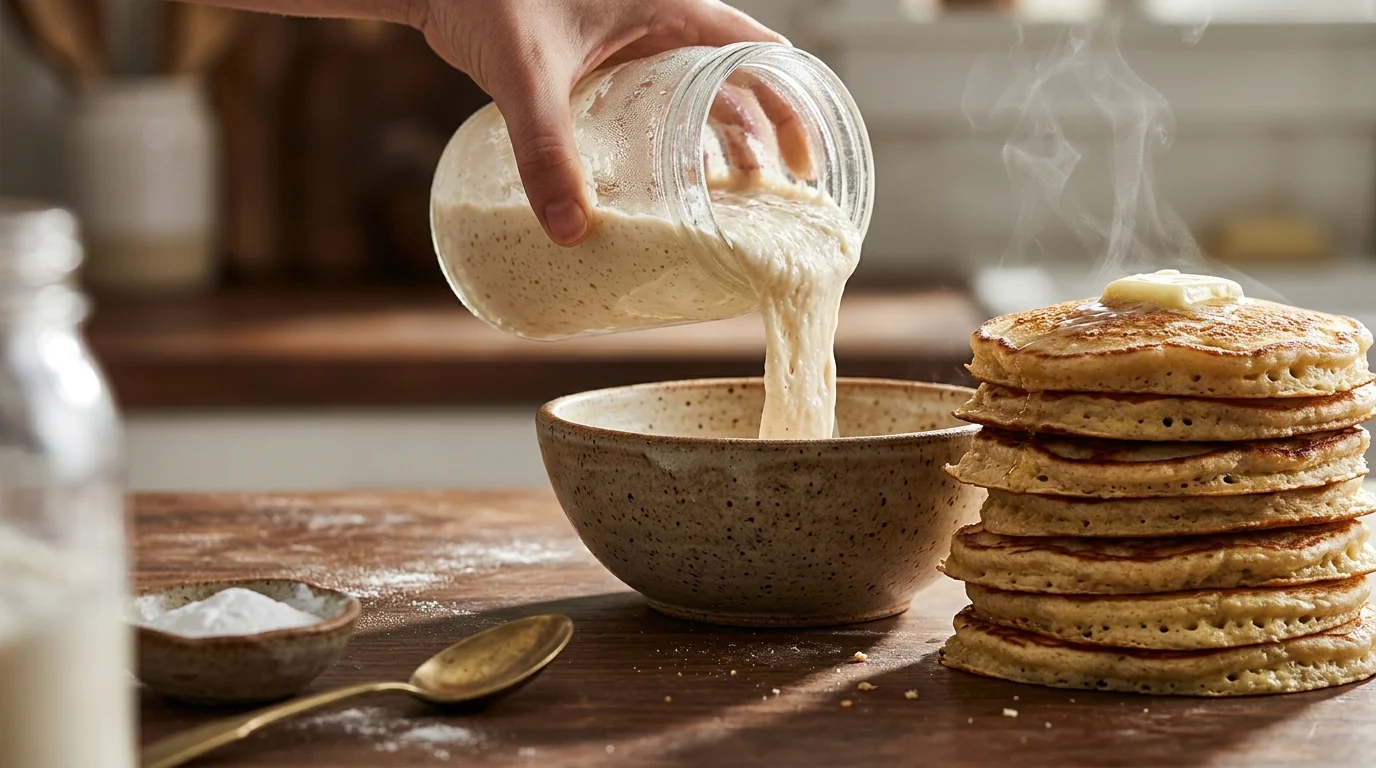
Kitchen lore and online baking forums sometimes warn home cooks that pouring cold, unfed sourdough starter discard directly from the refrigerator into pancake batter will ruin the final texture. According to this circulating culinary theory, refrigerated discard accumulates proteolytic enzymes that break down gluten networks, resulting in dense or gummy batters unless neutralized with baking soda. However, a review of available baking science and culinary reporting shows that this specific mechanism remains unverified, with no primary research or controlled kitchen testing proving that cold storage triggers destructive enzyme accumulation in pancake recipes.
While the viral theory attempts to apply complex cereal chemistry to everyday breakfast cooking, food science reporting indicates that the basic biological functions of a starter—yeast leavening and bacterial acidification—do not automatically translate into ruined griddle cakes when chilled. For home bakers across the United States looking to reduce kitchen waste by repurposing leftover starter, understanding what actually happens inside a jar of fermenting flour and water helps separate established kitchen science from unverified baking myths.
The Biology of Sourdough Starter
To evaluate how leftover starter behaves in a batter, it helps to examine what a sourdough culture actually is. According to The News & Observer, a sourdough starter is a living fermentation culture made from flour and water. Inside this mixture, wild yeasts and lactic-acid bacteria coexist and feed on the carbohydrates present in the grain.
Each microorganism performs a distinct job during fermentation. As reported by The Sacramento Bee, the yeasts produce carbon dioxide gas, which gets trapped in dough networks to make bread rise, while the lactic-acid bacteria produce organic acids. Those acids lower the overall pH of the mixture and generate the signature tangy flavor associated with sourdough baked goods.
When a baker maintains a starter at room temperature, they must regularly discard a portion of the mixture before adding fresh flour and water. Without removing that portion—known as discard—the culture would quickly outgrow its container and require massive amounts of flour to keep the microorganisms fed. Because discard is simply excess starter that has not been recently refreshed, bakers frequently store it in the refrigerator to slow down fermentation and accumulate enough volume for secondary recipes like pancakes, waffles, crackers, and flatbreads.
- Why Reverse Osmosis Water and Grind Settings Shape Sour Home Espresso Shots
- Why Stainless Steel Pans Stick: Preheating Science vs. Kitchen Myths
- Why Cooks Choose Manual Food Mills Over Immersion Blenders for San Marzano Tomatoes
- Swapping Kosher Salt Brands Can Change Recipe Salinity by Half in Volume Measurements
- Why Lean Proteins Dry Out in Air Fryers—And What Actually Fixes It
Evaluating the Enzyme and Gluten Breakdown Claim
The assertion that cold, unfed discard ruins pancakes hinges on the behavior of proteases—enzymes naturally present in flour and produced during fermentation. According to general fermentation summaries hosted on Scribd, proteases do break down protein chains during the fermentation process. In traditional bread baking, long fermentation times and highly acidic environments can gradually weaken gluten structures as these enzymes clip the protein strands that give bread dough its elasticity and strength.
However, a sharp conflict exists between this general bread-making principle and the specific claim regarding refrigerated pancake batter. While the circulating theory asserts that cold discard accumulates destructive levels of proteolytic enzymes that turn pancakes gummy, the retrieved culinary and scientific literature offers no direct testing or primary research connecting cold storage to harmful enzyme buildup in pancake batters. In fact, culinary science reporting from both The News & Observer and The Sacramento Bee details the acid-producing and leavening mechanics of sourdough cultures without identifying refrigeration as a trigger for enzymatic ruin in quick batters.
Additionally, pancakes rely on a very different structural foundation than artisan loaf bread. Bread requires a strong, well-developed gluten network to trap gas over several hours of proofing. Pancakes, by contrast, are delicate quick breads where excess gluten development actually produces tough, rubbery results. Because tender pancakes depend on minimal gluten formation, the premise that protease-driven gluten degradation causes a gummy texture runs counter to standard griddle-cake mechanics.
The Role of Baking Soda in Discard Recipes
The second half of the viral claim argues that bakers must add baking soda to cold discard batters specifically to neutralize proteolytic enzymes and save the pancake texture. Based on available food science documentation from Scribd and reporting in The News & Observer, there is no evidence establishing that baking soda directly neutralizes protease enzymes in this manner.
In practice, baking soda serves a well-documented chemical purpose in sourdough discard recipes: acid neutralization and rapid leavening. Because unfed discard sits in the refrigerator accumulating lactic and acetic acids from the bacteria, it has a distinctly low pH. When a baker stirs alkaline baking soda (sodium bicarbonate) into an acidic sourdough batter, an immediate acid-base reaction occurs. This reaction tempers the sharp sourness of the old starter and releases carbon dioxide bubbles, giving the pancake batter an instant lift on the hot griddle since the dormant, unfed wild yeast cannot leaven the batter quickly enough on its own.
What This Means for Home Bakers
For home cooks making weekend pancakes, there is no proven scientific reason to fear pulling sourdough discard straight from the refrigerator. If a batch of sourdough pancakes turns out dense or gummy, culinary researchers note that several basic kitchen variables are far more likely to be the culprit than cold-induced protease accumulation.
Bakers troubleshooting gummy pancake textures should consider practical adjustments:
- Check the leavening reaction: Ensure your baking soda or baking powder is fresh. In discard pancakes, chemical leaveners do the heavy lifting to create an airy crumb through their reaction with the starter’s natural acidity.
- Watch the hydration: Starters vary widely in water content. A thinner, liquid discard adds more water to a recipe than a stiff starter, which can throw off the flour-to-liquid ratio and create a heavy, wet center.
- Avoid overmixing: Stirring pancake batter too vigorously after adding the wet ingredients develops gluten directly from the fresh flour in the bowl, leading to chewy or rubbery results regardless of the starter’s temperature.
- Manage griddle temperature: Pouring cold batter onto an underheated skillet can cause the exterior to cook slowly while the interior steams into a dense layer, whereas an overly hot pan burns the outside before the center sets.
Frequently Asked Questions
Is there controlled research comparing pancakes made with cold discard versus room-temperature starter?
No. Available culinary and scientific records from sources like The News & Observer and The Sacramento Bee provide no controlled recipe tests demonstrating that cold refrigerated discard performs worse in pancakes than room-temperature discard or freshly fed starter.
Does baking soda change pancake texture by stopping enzyme activity?
The retrieved evidence does not show that baking soda neutralizes proteolytic enzymes. Instead, baking soda reacts with the organic acids produced by the starter’s lactic-acid bacteria, reducing sourness and creating carbon dioxide gas that makes the batter light and fluffy.
What factors actually explain a gummy texture in sourdough pancakes?
While proteases do break down protein chains during fermentation, food science context indicates that unmeasured starter hydration, flour type, overmixing the batter, improper griddle cooking temperatures, or insufficient leavening better explain a gummy pancake texture than cold enzyme accumulation.