Home baristas across the United States troubleshooting sharp, sour shots from their kitchen espresso machines often point to household water filtration as the culprit. While a popular premise suggests that reverse osmosis (RO) and zero-mineral filters strip out the magnesium and calcium ions required to pull balanced flavor compounds from dark-roasted beans, technical guides and water filtration analyses published between October 8, 2026, and October 14, 2026, show that the relationship between filtered water and espresso acidity is far less uniform.
Rather than treating all filtered water as devoid of minerals, brewing and water treatment reports indicate that mineral retention varies widely by system design. At the same time, espresso hardware guides emphasize that sour, thin shots are frequently driven by mechanical brewing variables—such as grind size, shot duration, and liquid yield—rather than water chemistry alone.
Reverse Osmosis Versus Standard Household Water Filters
A central point of confusion for home coffee brewers is the assumption that any household filter strips water of the dissolved ions that aid flavor extraction. In practice, standard carbon pitchers and refrigerator filters operate differently from membrane-based desalination or demineralization systems.
According to Checked Water and Frizzlife, reverse osmosis systems can reduce dissolved calcium and magnesium along with other substances, though the exact mineral volume remaining depends on the unit’s specific engineering. Checked Water notes that RO membranes reduce calcium and magnesium while referencing broader contaminant-removal summaries from the Centers for Disease Control and Prevention (CDC), though specific performance figures vary across individual household setups.
Even within the reverse osmosis category, mineral stripping is not universal. According to GetNews on October 13, 2026, modern under-sink tankless RO designs increasingly incorporate alkaline remineralization stages specifically built to restore minerals after the primary membrane filtration stage. Meanwhile, TN reported on October 14, 2026, that basic household water filtration removes unwanted odors and tastes without necessarily stripping out all dissolved minerals, making standard filtered tap water chemically distinct from distilled or unbuffered RO water.
- Why Stainless Steel Pans Stick: Preheating Science vs. Kitchen Myths
- Why Cooks Choose Manual Food Mills Over Immersion Blenders for San Marzano Tomatoes
- Swapping Kosher Salt Brands Can Change Recipe Salinity by Half in Volume Measurements
- Why Lean Proteins Dry Out in Air Fryers—And What Actually Fixes It
- Light, Heat, and Air Degrade Extra Virgin Olive Oil Even Under Careful Storage
How Dissolved Minerals Interact With Coffee Grounds
During coffee brewing, water acts as a solvent, and its dissolved mineral profile influences how aromatic oils, acids, and browned sugars migrate from roasted grounds into the cup. According to TN, calcium, magnesium, sodium, potassium, and bicarbonates all participate in coffee extraction, helping balance acidity and body when brewing at home.
When those mineral levels shift toward either extreme, cup quality suffers in recognizable ways. According to The Flaming Bean, water with overly low mineral content tends to produce flat or under-extracted coffee, whereas water heavy in dissolved minerals yields chalky or muddy flavors that mask delicate roast notes. However, while the broad premise circulated among some home baristas blames mineral-stripped water specifically for sour dark-roast espresso shots, The Flaming Bean characterizes low-mineral brewing outcomes as flat rather than establishing a universal mineral threshold that automatically triggers sourness in an espresso machine.
Mechanical Variables Behind Sour Espresso Shots
In the high-pressure environment of an espresso basket, water chemistry is only one piece of a fast-moving extraction puzzle. Differing reports highlight a split between blaming demineralized water and looking first at standard barista adjustments at the grinder and grouphead.
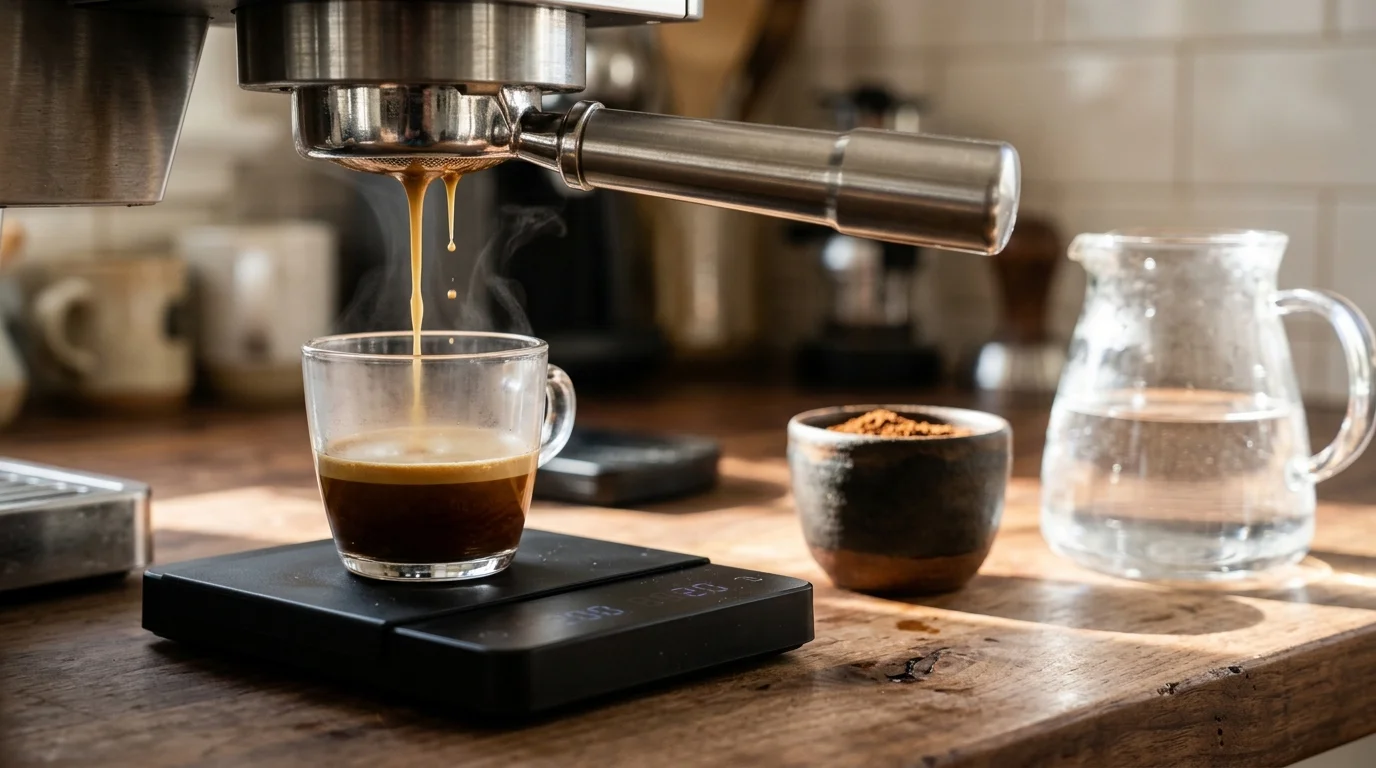
While the theory behind zero-mineral filtration focuses on missing magnesium and calcium ions, Meraki Tech reports that a sour, sharp, and thin espresso shot is a classic symptom of general under-extraction. Rather than identifying water chemistry as the primary or solitary cause of unpleasant acidity, Meraki Tech points home users toward mechanical adjustments—specifically grinding the coffee beans finer, increasing the liquid shot yield, or extending the total shot contact time.
Because organic acids are the first compounds to dissolve when hot water hits pressurized coffee grounds, a shot that runs too quickly or channels through coarse grounds leaves behind the heavier sugars and bitter compounds that normally round out the palate. Without controlled testing that holds grind size, dose weight, water temperature, roast level, and flow rate constant, attributing a sharp shot solely to a household water filter can lead home baristas to overlook simple dial-in fixes.
Key Questions for Home Baristas Evaluating Their Water
Because household water supplies and filtration setups vary across regions, evaluating whether water chemistry is affecting your daily espresso requires separating mechanical variables from filtration specs.
What type of water filter is installed in the kitchen?
Homeowners should distinguish between standard activated-carbon pitcher or refrigerator filters, whole-house ion-exchange water softeners, standalone reverse osmosis membranes, and RO systems equipped with post-filtration remineralization cartridges. Each technology leaves behind a different mineral footprint.
What are the measured mineral and alkalinity levels before and after filtration?
Without testing the water’s calcium, magnesium, alkalinity, and total dissolved solids before and after it passes through a filter, baristas cannot confirm whether their system is stripping out extraction-assisting ions or leaving enough bicarbonate buffer to balance coffee acidity.
Have grind, dose, yield, and temperature been held constant?
To determine whether low-mineral water is contributing to sourness, baristas must first lock in a consistent grind setting, dry dose, liquid yield, brew temperature, and bean roast on the same machine. Adjusting grind fineness or lengthening the extraction ratio often resolves sharpness before water chemistry changes are necessary.
What do espresso machine manufacturers specify for water and warranty rules?
Home espresso machine owners must balance flavor goals with boiler protection. Calcium and magnesium contribute to limescale buildup inside heating elements and valves, while purely distilled or zero-mineral water can interfere with electronic water-level sensors or corrode certain metals. Checking the manufacturer’s manual for acceptable water chemistry and descaling intervals protects both cup quality and warranty coverage.
Sources
- Checked Water – How Reverse Osmosis Works
- Frizzlife – Does Reverse Osmosis Soften Water: RO System vs Water Softener
- GetNews – Viomi Showcases Family-Ready Tankless RO Systems Featuring Extended Filter Longevity, Alkaline Remineralization, and Low-Maintenance Under-Sink Design
- TN – Los expertos en café coinciden: el error más común al prepararlo en casa es no filtrar el agua
- The Flaming Bean – Coffee for Black Coffee Drinkers
- Meraki Tech – Espresso Extraction: From Grounds to Golden Cup