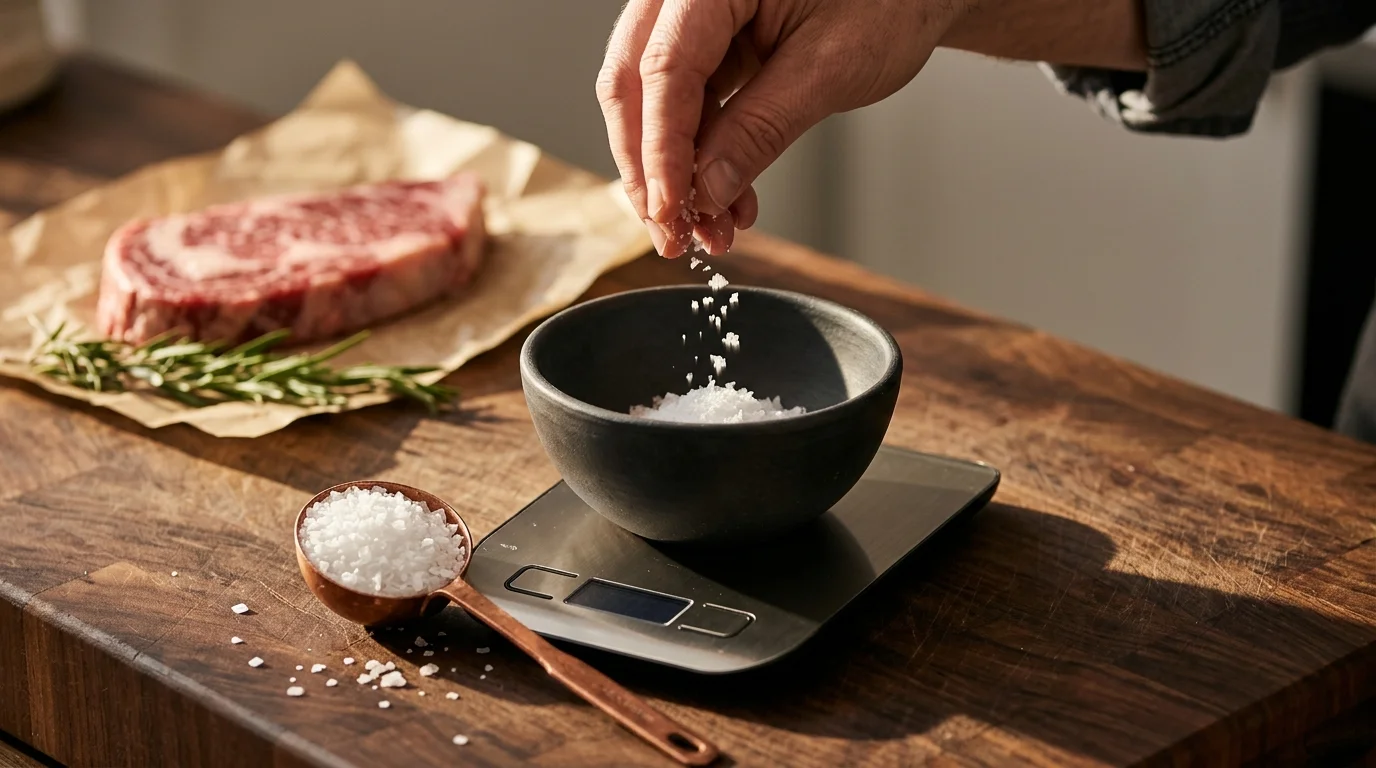
Home cooks and professional recipe developers across the United States face a persistent kitchen variable whenever they reach for the salt cellar: swapping one brand of kosher salt for another by volume can alter a dish’s salinity by roughly half. In recipe instructions updated in October 2026, test kitchen editors and culinary specialists continued to warn readers that Morton and Diamond Crystal kosher salts do not measure equally in teaspoons or tablespoons, prompting strict conversion guidelines to prevent over-salted stews, brines, and cured meats.
The issue centers on bulk density—how tightly individual salt crystals pack together inside a measuring spoon and how much air remains between the grains. While culinary guidance frequently points to a two-to-one volume ratio between the two leading American kosher salt brands, culinary reference guides note that only weight-based measurements eliminate the guesswork caused by differing crystal structures.
Why Volume Measurements Vary Between Brands
When a recipe calls for a tablespoon of kosher salt without specifying a brand, the final flavor of the dish depends heavily on which box sits in the cook’s pantry. According to a recipe note published by Good Housekeeping, its test kitchen standardizes recipes using Diamond Crystal kosher salt and advises home cooks to use about half as much when substituting Morton kosher salt by volume.
This practical kitchen adjustment reflects the physical reality of how salt grains occupy space. According to a meat-curing and salting guide from AmazingRibs, both the physical size of the salt grain and the microscopic air spaces between those grains determine the actual amount of sodium chloride sitting inside a measured spoon or cup. Smaller or denser grains settle closely together with minimal air pockets, whereas larger, irregular flakes leave significant empty space inside the same measuring vessel.
The contrast becomes even sharper when comparing kosher salt to standard granulated table salt. According to AmazingRibs, a single teaspoon of fine table salt contains almost twice as much sodium chloride as a teaspoon of Morton coarse kosher salt. Because of these structural discrepancies, recipes developed and standardized around one specific salt brand will not yield the same chemical or sensory results when prepared with another using volume spoons.
Examining Manufacturing Claims and Density Ratios
In professional kitchens and culinary media, the difference between the two dominant kosher salt brands is commonly attributed to contrasting manufacturing methods—specifically the assertion that Morton produces dense, flat flakes by rolling salt under pressure, while Diamond Crystal forms hollow, pyramid-like flakes through vacuum evaporation, resulting in a tablespoon of Morton weighing nearly twice as much as Diamond Crystal.
However, a closer look at published recipe advisories and technical curing guides reveals a distinction between kitchen rules of thumb and documented physical testing. While the Good Housekeeping test kitchen provides the practical instruction to use about half as much Morton when a recipe calls for Diamond Crystal, that guidance serves as a kitchen conversion convention rather than a controlled laboratory measurement proving that one brand weighs twice as much across all production batches.
Similarly, while AmazingRibs confirms that kosher salt brands vary significantly in salinity by volume and standardizes its own formulas on Morton coarse kosher salt, its published ratio compares table salt to Morton rather than establishing a direct weight ratio between Morton and Diamond Crystal. Neither source provides independent technical documentation verifying the rolling-versus-vacuum-evaporation manufacturing processes or a universal fifty-percent weight differential per level tablespoon.
High Stakes in Brining, Curing, and Slow Cooking
In everyday stovetop cooking, an unexpected surge in salinity can ruin the balance of a meal. In a dish like the slow-cooker sweet potato and peanut stew featured by Good Housekeeping, adding a full measure of a denser kosher salt instead of scaling back by about half can overwhelm the natural sweetness of the root vegetables and the richness of the peanut broth during a long simmer.
In meat preservation, charcuterie, and wet brining, the margin for error narrows from a matter of taste to a matter of food safety and protein chemistry. As AmazingRibs notes in its curing documentation, precision in sodium chloride concentration is critical when preserving meats. Too little salt fails to inhibit microbial growth or properly denature muscle proteins for moisture retention, while excessive salt leaves cured cuts unpalatably harsh. Because volume measurements fluctuate based on crystal geometry and how firmly a cook packs the measuring cup, specialist guides explicitly caution against swapping salt types without adjusting the measurement method.
What This Means for Home Cooks
For readers navigating recipes from different cookbooks, magazines, and food websites, understanding how publishers standardize their ingredients is the simplest way to avoid salinity mishaps. Cooks have two reliable strategies in the kitchen:
- Check the recipe source’s baseline salt: Many modern test kitchens explicitly state which kosher salt they use in their recipe notes. If a recipe developed with Diamond Crystal calls for kosher salt by the teaspoon and you only stock Morton, follow the Good Housekeeping benchmark by starting with about half the stated volume and seasoning to taste toward the end of cooking.
- Measure salt by weight rather than volume: Using a digital kitchen scale eliminates the variable of air pockets and crystal size entirely. Whether the salt is fine table grain, coarse rolled flake, or light hollow crystal, a gram of pure sodium chloride delivers the exact same salinity regardless of the logo on the box.
Frequently Asked Questions
Does the half-volume conversion rule apply to every recipe, or is weighing in grams better?
Using about half as much Morton when a recipe specifies Diamond Crystal works well as a practical estimate for general cooking, such as soups, stews, and roasts. However, because spoon shapes, crystal settling, and batch variations can affect volume spoons, measuring salt by weight on a digital scale is far more reliable—especially for baking, brining, and meat curing where exact salinity affects food texture and safety.
Why do different kosher salts have different salinity levels in the same measuring spoon?
As documented by AmazingRibs, the size and shape of salt crystals dictate how much empty air space exists between the grains inside a measuring spoon. Flakier, more irregular crystals trap more air and put less actual salt into a teaspoon, whereas smaller or flatter crystals pack tightly together, increasing the total weight of sodium chloride in the same volume.
Can package nutrition labels verify the weight difference between kosher salt brands?
Package nutrition panels list serving sizes by volume (typically a quarter teaspoon) alongside a corresponding weight in grams, which can offer a rough comparison of bulk density. However, because label rounding rules and how a cook scoops or levels a tablespoon introduce variability, controlled kitchen weighing remains the only accurate way to confirm exact weights across different boxes and production lots.