Home cooks across the United States frequently pull boneless chicken breasts, pork tenderloin, and flaky white fish from their countertop air fryers only to find the meat chalky and tough. A popular culinary theory blames this texture on excessive fan velocity, claiming the compact appliance strips away surface moisture faster than internal fat can render and requires a strict oil-basting protocol to imitate deep frying.
However, culinary guidance and appliance documentation show that air-speed thresholds alone do not condemn lean meats to dryness. According to All Kitchen Tips, an air fryer functions as a compact countertop convection oven rather than a true fryer. While rapid air circulation does accelerate surface evaporation, overcooking, uneven cut thickness, and skipping a thermometer are the primary culprits behind dry lean protein—not a lack of continuous oil basting.
How Compact Convection Handles Surface Moisture
The modern countertop air fryer, popularized in consumer kitchens after its 2010 introduction by Philips, relies on two primary hardware components: a concentrated nickel-chromium heating coil positioned directly above the cooking chamber and a high-speed fan. Depending on the specific model and setting, the heating element generates temperatures between 180°F and 500°F, though most everyday recipes operate within the 350°F to 400°F range.
In a breakdown of appliance mechanics, All Kitchen Tips notes that fans in some units spin at over 1,800 RPM, while a separate guide from All Kitchen Tips describes airflow moving through the perforated basket at speeds of up to 200 miles per hour. Regardless of how individual manufacturers measure airflow, the mechanical goal remains the same: the fan pulls air past the glowing heating element and forces it downward around the food, removing the cool boundary layer of air that naturally insulates raw ingredients.
This forced convection sweeps away surface water so the exterior can reach temperatures above 280°F to 300°F. At that heat threshold, amino acids and reducing sugars undergo the Maillard reaction, creating savory flavor compounds and a browned crust. Because the cooking chamber is small and heats up in 2 to 4 minutes—compared to 10 to 15 minutes for a conventional full-size oven—heat transfer happens 20% to 30% faster.
The Rendering Myth vs. Lean Muscle Fibers
The claim that fan velocity strips moisture faster than internal fat can render misunderstands the anatomy of lean cuts. Boneless, skinless chicken breasts, turkey cutlets, and cod fillets contain very little intramuscular fat to render in the first place. Their perceived juiciness depends almost entirely on retaining the natural water bound within their muscle fibers.
When lean protein turns stringy in an air fryer, the issue is rarely the speed of the fan alone. Instead, because an air fryer transfers convective and radiant heat so rapidly, home cooks who rely on standard oven timers inadvertently push the internal temperature of the meat well past safe doneness. As muscle fibers overheat, they contract tightly and squeeze out their internal water, leaving the meat dry long before the timer chimes.
Furthermore, current kitchen literature offers no controlled testing to support the claim that a mandatory mid-cycle oil-basting protocol is required to rescue lean proteins or replicate deep-fat frying. While All Kitchen Tips recommends applying 1 to 2 teaspoons of a high-smoke-point oil—such as avocado, canola, or vegetable oil—to low-fat foods like lean chicken, this step serves as a surface conductor. Oil conducts heat more efficiently than air, helping spices adhere and accelerating exterior browning, while reducing overall oil consumption by up to 75% to 80% compared to submerging food in 4 to 6 cups of deep-frying oil.
Practical Techniques for Juicy Air-Fried Proteins
Rather than repeatedly opening the basket to baste lean cuts with oil—which releases trapped heat without rehydrating muscle fibers—home cooks can protect moisture by adjusting preparation and temperature settings:
- Cut or Pound to Uniform Thickness: Tapered chicken breasts cook unevenly under a top-mounted heating coil, drying out at the thin tail before the thick center is safe to eat. Pounding poultry to an even thickness ensures uniform heat penetration.
- Dial Back Time and Temperature: When converting a conventional oven recipe for an air fryer, reduce the total cooking time by 20% to 25% and inspect the food 5 minutes early. Delicate items like fish fillets benefit from moderate settings between 250°F and 300°F so the exterior does not desiccate before the center cooks through.
- Pat Dry, Then Lightly Coat: Blot thawed or rinsed meat dry with a paper towel so surface water does not steam the exterior. Brush or spritz 1 to 2 teaspoons of oil across the surface to promote an even crust and limit surface dehydration.
- Give Pieces Breathing Room: Arrange proteins in a single layer on the perforated crisper plate. Overcrowding blocks the airflow path, trapping steam in pockets while exposing the upper edges to prolonged direct radiation from the top coil.
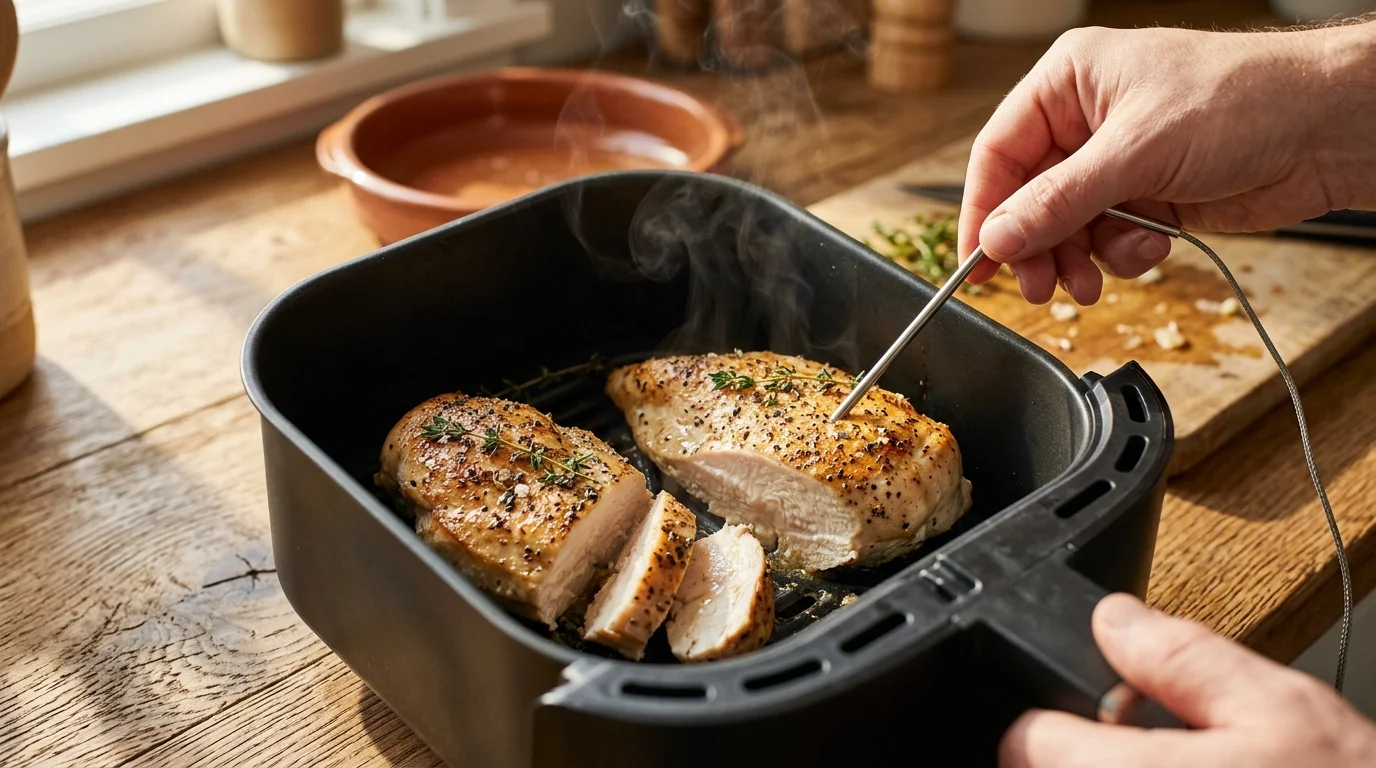
- Flip Halfway and Verify with a Thermometer: Turn cutlets or fillets once mid-cycle with tongs so both sides brown evenly, and pull the meat as soon as a digital thermometer confirms safe internal temperatures—165°F for poultry and 145°F for fish.
Frequently Asked Questions
How do air fryer fan speeds compare with standard convection ovens?
Both appliances use fans to circulate heated air, but air fryers house their fans right next to the heating element inside a compact chamber. Some air fryer fans spin at over 1,800 RPM, directing concentrated airflow straight through a perforated basket rather than dispersing it across a wide oven cavity.
Does brushing or spraying oil improve internal juiciness or surface browning?
A light coat of 1 to 2 teaspoons of oil primarily improves surface heat conduction and accelerates the Maillard reaction for better browning and crust texture. While a thin lipid barrier helps slow surface dehydration on low-fat foods, internal juiciness depends on pulling the protein from the heat as soon as it reaches its target internal temperature.
Why do thick cuts of meat sometimes dry out on the outside before cooking through?
Because the heating element in most basket-style air fryers sits directly above the food, setting the appliance to its maximum 400°F to 500°F range blasts the exterior with intense radiant and convective heat before conduction can warm the center. Lowering the temperature allows heat to travel evenly to the core without scorching or drying out the outer layers.