Kitchen wisdom often cautions cooks against taking a high-speed immersion blender to a pot of San Marzano tomatoes, warning that shearing the seeds releases astringent polyphenols that turn the sauce bitter. While home cooks and chefs regularly turn to manual food mills to process whole plum tomatoes into smooth passata, culinary documentation and recent consumer comparisons examined in October 2026 show a gap between kitchen lore and verified food chemistry. Although a manual food mill physically removes seeds and skins from the pulp, available reporting does not independently verify that pulverized tomato seeds release enough phenolic compounds to make San Marzano sauce bitter.
The Bitterness Claim Versus Culinary Evidence
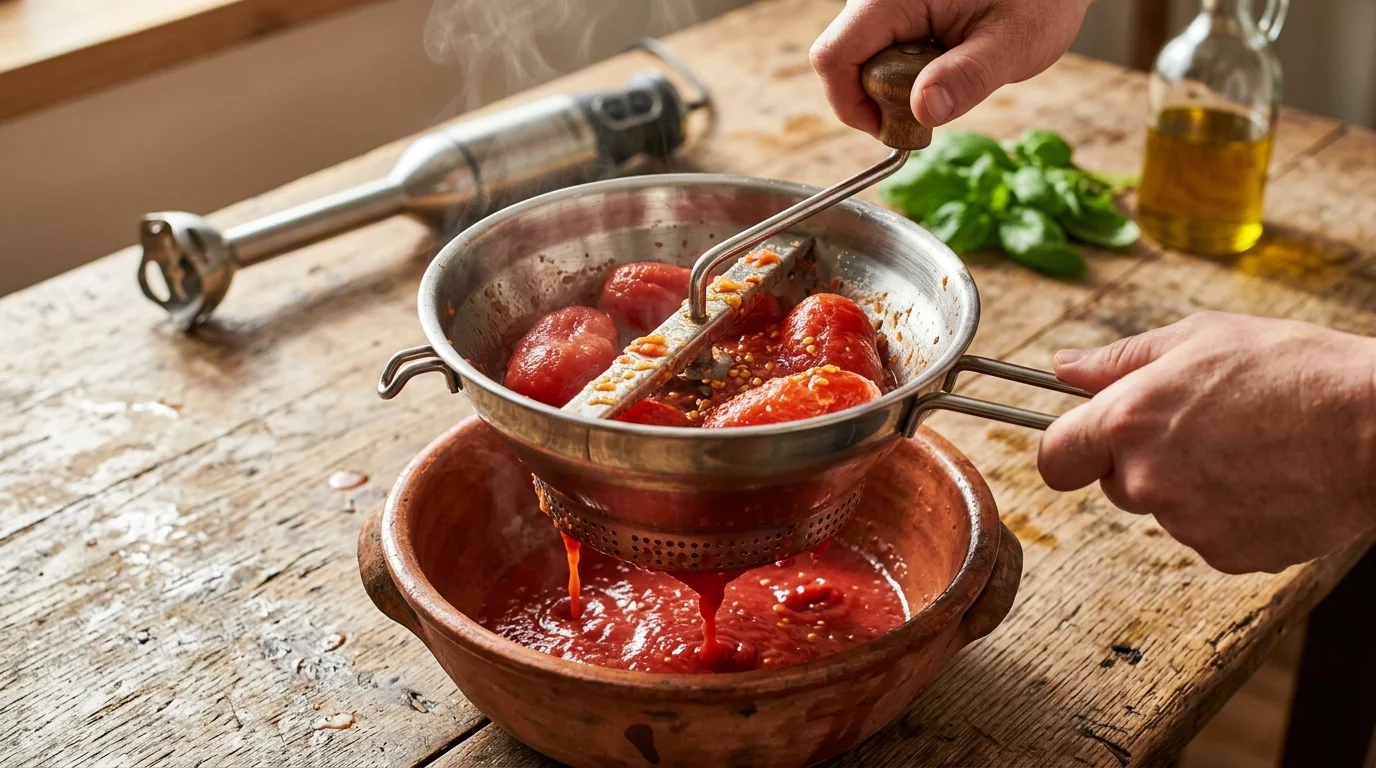
The debate over how best to puree canned or fresh plum tomatoes centers on mechanical force. According to the popular culinary claim, the rapidly spinning metal blades of an immersion blender shatter tomato seeds, releasing bitter, astringent polyphenols directly into the surrounding liquid. By contrast, passing whole tomatoes through a hand-cranked food mill gently presses the soft flesh through a perforated metal disk while leaving tough skins and intact seeds behind.
However, separating what a tool does physically from how it alters flavor chemistry is critical. While general nutritional commentary from Acibadem International notes that tomatoes naturally contain phenolic compounds, available reporting does not confirm the specific causal claim that immersion-blender seed shearing causes bitterness in tomato sauce. Similarly, no retrieved culinary or food-science analysis directly measures a bitterness change between blended and milled San Marzano sauces.
What is thoroughly documented is the mechanical advantage of traditional milling. According to Appetito Magazine, traditional Italian passata preparation relies on heating tomatoes until their skins split and then cranking them through a food mill specifically to separate the skins and seeds from the rich pulp. Whether or not broken seeds introduce measurable astringency, keeping them out of the pot guarantees a cleaner, more uniform texture that high-speed blades cannot replicate without whipping air into the puree.
- Swapping Kosher Salt Brands Can Change Recipe Salinity by Half in Volume Measurements
- Why Lean Proteins Dry Out in Air Fryers—And What Actually Fixes It
- Light, Heat, and Air Degrade Extra Virgin Olive Oil Even Under Careful Storage
- Cast Iron Makers Confirm Dish Soap Is Safe, Though Rancid Seasoning Claims Lack Proof
What Sets True San Marzano Tomatoes Apart
Ironically, the specific tomato variety most frequently linked to the seed-bitterness warning is prized precisely because it contains very few seeds to begin with. In an October 8, 2026 comparison published by Yahoo Lifestyle, evaluators noted that genuine San Marzano tomatoes are distinctively long and slender, featuring dense flesh and noticeably fewer seeds than standard plum tomatoes.
That structural density makes the cultivar ideal for cooked sauces. With thicker walls and smaller seed cavities, the fruit yields a concentrated pulp that breaks down smoothly over heat without becoming watery. Because authentic San Marzano tomatoes already carry a naturally low seed count, the physical volume of seeds exposed to an immersion blender blade is inherently lower than in conventional Roma or standard canned plum varieties.
Still, American shoppers paying a premium for these traits frequently encounter confusion in the canned goods aisle. As Yahoo Lifestyle reports, genuine San Marzano tomatoes must be grown and processed within a designated geographical area of Campania, Italy, with qualifying cans carrying the European Union’s Protected Designation of Origin (DOP) seal. Supermarket shelves also stock domestic or imported cans labeled as “San Marzano-style” tomatoes, which do not carry the same origin guarantee and may differ in flesh density, acidity, and seed content.
How Technique Shapes Sauce Texture and Flavor
Even without a clinical study proving that sheared seeds leach astringent polyphenols into a simmering pot, choosing between a food mill and an immersion blender remains an important practical decision for home cooks. When an immersion blender runs at high speed inside a saucepan, the vortex draws air into the liquid and emulsifies micro-fragments of skin and seed coat alongside the pulp. That aeration frequently turns a vibrant crimson sauce pale orange, requiring longer simmering times to drive off trapped air and restore the deep red hue.
A manual food mill avoids aeration entirely. By scraping the cooked fruit across a stainless-steel sieve, the mill retains the deep ruby color of the tomato flesh while physically trapping fibrous peel and hard seeds above the grate. For cooks working with whole canned tomatoes, gentle alternative methods—such as crushing the fruit by hand in a mixing bowl or pressing it with a potato masher—also preserve color and leave any stray seeds whole.
Frequently Asked Questions
Is there a controlled study comparing San Marzano sauce made with an immersion blender versus a food mill?
No controlled sensory or food-chemistry study in the available reporting compares San Marzano sauce processed with an immersion blender against sauce passed through a manual food mill. While cooks frequently observe differences in color and texture, the specific chemical mechanism linking blended seeds to polyphenol bitterness remains unverified in current literature.
Do bitter compounds come from tomato seeds during ordinary cooking?
Although general nutritional sources such as Acibadem International note that tomatoes contain phenolic compounds, available sources do not establish that ordinary kitchen blending releases enough seed-derived compounds to turn a sauce noticeably bitter.
What label language should US shoppers check to buy authentic San Marzano tomatoes?
According to Yahoo Lifestyle, shoppers should check the label for the DOP (Denominazione d’Origine Protetta) certification and verify that the tomatoes were grown and packed in the designated region of Campania, Italy. Cans labeled “San Marzano-style” do not meet these protected-origin standards.
If seed shearing is not proven to cause bitterness, what else could explain taste differences?
Variations in flavor and mouthfeel between sauces often stem from tomato variety, ripeness at harvest, natural acidity, cooking duration, and whether skins and air are whipped into the puree during high-speed blending rather than separated out with a traditional mill.