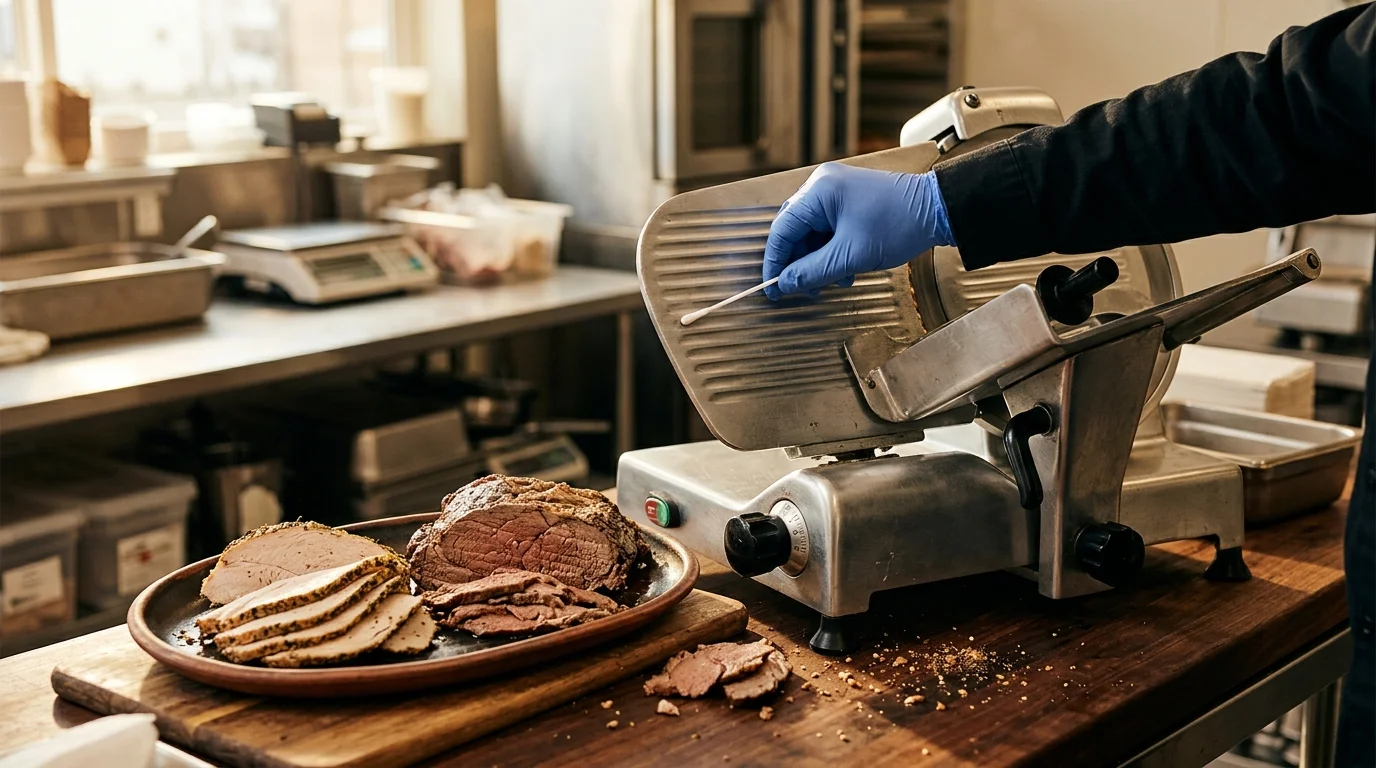
Federal food safety regulators are rolling out a stricter environmental testing regime for ready-to-eat (RTE) deli meat processors across the United States in early 2027. According to Food Safety News, the U.S. Department of Agriculture’s Food Safety and Inspection Service (FSIS) will launch a nationwide environmental sampling program phased across nine regulatory districts from January through March 2027. The initiative aims to catch hidden bacterial contamination in processing facilities before products reach grocery store deli counters and restaurant kitchens.
The regulatory push follows heightened scrutiny of the cold-cut supply chain and persistent industry discussions regarding equipment sanitation. While unverified industry claims have suggested that recent federal inspections pinpointed persistent bacterial biofilms on commercial meat slicers bypassing overnight chemical washdowns, published regulatory reporting tells a more measured story. Rather than confirming widespread slicer biofilm failures at regional processing plants, verified reports document a proactive federal effort to broaden surface swabbing and assess how effectively individual plants manage sanitation.
Inside the 2027 FSIS Sampling Program
Under the expanded framework detailed by Food Safety News, federal inspectors will conduct targeted surface testing whenever they collect routine ready-to-eat product samples at deli meat establishments. Each sampling event will consist of four environmental swabs: two taken directly from food-contact surfaces and two collected from non-food-contact surfaces within the plant.
Laboratory teams will analyze these swabs for both Listeria monocytogenes—a dangerous pathogen capable of surviving and growing in refrigerated environments—and other indicator Listeria species. FSIS officials stated that the expanded protocol is designed to identify potential bacterial harborage sites, evaluate the real-world effectiveness of sanitation procedures at individual establishments, and give regulators a clearer picture of nationwide contamination trends.
Before announcing the national rollout, FSIS ran a pilot version of the environmental sampling program across three regulatory districts: Alameda, Chicago, and Raleigh. However, Food Safety News noted on October 13, 2026, that the agency had not yet published the data from those pilot districts, limiting public conclusions about specific equipment failures or regional sanitation trends identified during the trial phase.
- Cocoa Market Data Challenges Claims of US Bakery Coating Switches
- Claims That Cold Sourdough Discard Ruins Pancake Texture Lack Scientific Proof
- Why Reverse Osmosis Water and Grind Settings Shape Sour Home Espresso Shots
- Why Stainless Steel Pans Stick: Preheating Science vs. Kitchen Myths
- Why Cooks Choose Manual Food Mills Over Immersion Blenders for San Marzano Tomatoes
Separating Plant Realities from Slicer Claims
In the wake of major cold-cut recalls, industry observers and consumers frequently question how pathogens survive inside modern food facilities. A prominent point of friction involves the distinction between federal meat-processing plants and retail or restaurant kitchens, as well as what official records actually confirm regarding commercial slicers.
The heightened regulatory focus traces back to the severe 2024 listeriosis outbreak tied to Boar’s Head provisions. According to the Butler Eagle, Boar’s Head permanently closed its Jarratt, Virginia, facility in September 2024 after an internal investigation attributed the fatal contamination to a specific production process used exclusively at that plant for making liverwurst. Federal inspection records from the preceding year had documented 69 instances of noncompliance at the Jarratt facility, including mold, insects, ceiling drips, and meat or fat residue left on walls, floors, and equipment. While those 69 citations demonstrated severe structural and sanitation lapses, the report did not identify commercial slicer biofilms or failed overnight chemical washdowns as the source of the outbreak.
Under federal regulations cataloged by GovRegs, meat-processing establishments must develop, implement, and document a written Hazard Analysis and Critical Control Point (HACCP) plan whenever a hazard analysis identifies a food-safety risk reasonably likely to occur. While plants must maintain strict sanitation documentation under these rules, federal statutory text does not dictate a single, uniform overnight chemical washdown metric for commercial slicers across all plants; rather, each facility must validate and document its own specific hazard controls.
By contrast, verifiable citations involving dirty meat slicers frequently appear in local health department reports covering restaurants and retail delis—settings governed by state and county codes rather than continuous USDA processing inspection. For example, an October 8, 2026, local inspection report published by LancasterOnline highlighted a Chester County, Pennsylvania, restaurant cited for accumulated food debris on a deli slicer. Under those local food code standards, operators are required to thoroughly wash, rinse, and sanitize food-contact surfaces after use and at least once every four hours during continuous operation. Food safety analysts emphasize that retail slicer neglect should not be conflated with federal meat-packing inspection findings.
What This Means for Kitchens and Consumers
For commercial kitchen operators, delicatessen managers, and everyday consumers, the distinction between processing plant oversight and retail maintenance is critical. Ready-to-eat deli meats do not undergo a final cooking step in the home kitchen, meaning any bacteria introduced during manufacturing or retail slicing remains viable on the food.
At the processing level, the upcoming 2027 FSIS swabbing mandate will pressure regional and national meat packers to aggressively hunt down damp, hard-to-reach niches where Listeria can settle. By testing both food-contact machinery and surrounding non-food-contact surfaces—such as floors, drains, and structural framework—inspectors can spot environmental encroachment before the bacteria transfer onto conveyor belts or slicing blades.
In restaurant and grocery store delis, adhering to the four-hour wash, rinse, and sanitize cycle remains the frontline defense. Commercial slicers feature complex seams, blade guards, and carriage trays that easily trap protein and fat residue if staff merely wipe them down between orders rather than disassembling them for proper chemical sanitization.
Frequently Asked Questions
Do published USDA reports confirm widespread slicer biofilms in regional plants?
No. While unverified summaries have claimed that USDA inspection reports exposed persistent biofilms on commercial slicers bypassing overnight chemical washdowns, published reporting in Food Safety News shows that results from the recent FSIS environmental sampling pilot in Alameda, Chicago, and Raleigh have not yet been released. Documented plant failures, such as the 69 noncompliance records at the shuttered Boar’s Head facility in Virginia, involved broad sanitation issues like meat residue on equipment, ceiling drips, and mold rather than confirmed slicer biofilm.
How does federal plant inspection differ from restaurant slicer rules?
Federal meat-processing plants operate under USDA FSIS oversight, which requires custom, documented HACCP plans (GovRegs) and upcoming four-swab environmental Listeria checks. Restaurant kitchens and retail deli counters are inspected by state or county health departments, which enforce local retail rules—such as the requirement reported by LancasterOnline to wash, rinse, and sanitize deli slicers after use and at least every four hours.
When will the expanded USDA deli meat testing begin?
FSIS plans to phase in the expanded environmental sampling program across nine regulatory districts between January and March 2027.
Sources
- Food Safety News – USDA to expand testing for deli meat processors
- Butler Eagle – Boar’s Head closing Virginia plant linked to deadly listeria outbreak
- LancasterOnline – Meat observed thawing at room temperature: Chester County restaurant inspections, Oct. 8, 2026
- GovRegs – 9 CFR 417.2 Hazard Analysis and HACCP Plan